Sunday, October 30, 2016

Barbie: Not Just a Little Doll?

Image result for barbie doll 1960Once upon a time, Barbie was considered as one of the most popular toys of all time; in fact, it has sold over one billion since her introduction to the market in 1959, easily becoming one of the most recognizable toys in history. Barbie was seen by everyone as a mainstream harmless play toy for little girls.

Little did they know that this "harmless" Barbie doll was an attack on Feminism.

Today, some argue that Barbie over sexualizes women. Her body features are exaggerated beyond comprehension. It is so bad that "it is a fact of Barbie's design that her [two pink elephants on her chest] are so out of proportion to the rest of her body that if she were a human woman, she'd fall flat on her face" (Prager 2).  The fact that Barbie was designed by a man instead of a woman conveys the fact that Barbie was created as the most attractive and ideal image of a woman that all men would love. In addition, it is almost natural that Barbie's body features were enlarged so much. This is because since Barbie was designed by a man, he would try to make Barbie the polar opposite of a man, due to the opposite genders, by hyperbolizing the features of a woman that men do not have. Also, the fact that Barbie's "sexual equipment" was heavily dramatized while Ken's wasn't conveys the false idea that women all people who gasconade their body to attract males and make love. Also, the ancient origin of this thought suggests that it's almost as if this mentality was set in stone by Jesus and had to be religiously followed. It is "as if we're trapped in Barbie's world and can never escape"(Prager).  All things considered the rhetoric Prager uses boils down to one word: injustice.

Image result for gender stereotypesRelated imageImage result for injustice word

Saturday, October 22, 2016

Race: Socially Created or Biologically Created?

Race. It is a concept that has plagued the human mind for centuries. Starting from the colonies and slavery to the Holocaust with Jews and Germans, not only does it have and ancient origin, but is also determined how people acted toward each other. For example, during the creation of the American colonies slaves were seen as objects whose only purpose was to do menial work for "superior" white Americans. During the Holocaust, Germans considered the existence of Jews to be pointless and as a result exterminated millions of Jews. In fact, they taught their children to call out Jews and run away from them and also taught them to "'Be careful!' because '[Jews] will catch you to a bag and eat you!'" (Spiegelman 149). 


Although race has defined humans since centuries ago, one question still remains: How was it created, biologically or socially? 

On one side, some consider race as a biologically constructed concept, saying that race is defined by genetics. They say that all people of a certain race have a certain set of genes that make them the race that they are. For example, they claim that the dark pigmentation of African American skin is the result of genetics in the genes that code for melanin. Therefore, through a scientific lens, they consider race a biologically constructed concept. 

On the other hand, many others say that race is a socially constructed concept. They say that race is not a concrete subject: “Unlike a mountain, the existence of race requires that people collectively agree and accept that it does exist” (Lusca, Race As A Social Construct). 

In my opinion, I would consider race as a socially constructed concept. Although the claim that the dark pigmentation of African American skin is the result of genetics in the genes that code for melanin is true, it would make the fact that Blacks were considered inferior to Whites paradoxical. This is because even though the black pigmentation of skin is scientifically considered a dominant trait among humans, they were still socially treated recessively. The bottom line is that skin color is biologically constructed while race, the human interpretation of skin color, is socially constructed.

Image result for raceRelated imageImage result for there is only one race the human race

Sunday, October 16, 2016

Maus: The Antithesis of Comics?

Image result for the green lantern comicI always used to think that comics were only for entertainment and comical value. For example, back in middle school, my friends always were reading "Green Lantern" and it was filled with action scenes and humor. After reading some of it, I realized that its language was very basic and that the cartoonish illustrations took all the seriousness away from the story. Therefore, I then associated comics with younger-aged audiences and humorous subjects.

Image result for MausThen, I picked up Maus.

Initially, when I heard that Maus won the Pulitzer, I instinctively thought it was a novel. But then after coming to know that Maus was a comic that is about the Holocaust, I wondered, "First of all, how can the humorous medium of a comic talk about such a serious topic like the holocaust? Second, how did this informal form win the Pulitzer, one of the most prestigious titles for all literary works?"

All my initial thoughts about comics took a 180 degree turn as I read Maus, a literary masterpiece.

Maus was different from all the comics I have ever seen. In fact, I would say that it is the polar opposite of what comics are perceived as. Instead of talking about a humorous subject, it talks about one of the most horrific tragedies in world history: the Holocaust. In addition to a serious subject, everything Spiegelman does in his graphic novel has a purpose.

For example in the page above, Spiegelman uses a circular frame to complete the wheel of the stationary bike Vladek is riding. This symbolic for Vladek's attempt to forget his memories of the Holocaust of which he lived through. His pedaling indicates his effort to forget his experiences of the Holocaust but the fact that an exercise bike doesn't move anywhere suggests that Vladek is not going anywhere with his efforts to forget. Therefore, Spiegelman’s use of a circular frame serves to show the impossible task of forgetting the terrifying Holocaust.


Not only has Art Spiegelman showed me that comics can be just as good as written novels, but he also proved once again that a picture can tell a thousand words.
Image result for deeper meaningImage result for picture of the word "picture"Related image

Sunday, October 9, 2016

Human Nature: The Definition of Obliviousness?

Image result for david foster wallace kenyon college commencementBack when I was younger, if someone were to ask me how aware I was of my surroundings, I would have said that I was mostly aware of what was around me. However, this all changed after reading the introduction of David Foster Wallace's commencement address at Kenyon College.


Image result for two fish david foster wallace
"These are these two young fish swimming along, and they happen to meet an older fish swimming the other way, who nods at them and says, 'Morning boys, how's the water?' And the two young fish swim on for a bit, and then eventually, one of them looks over at the other and goes, 'What the hell is water?'" (Wallace 1.1-5).


As I read this short fable, that same certainty I once had in my awareness of my surroundings turned into complete doubt. As I read the fable, I thought to myself, "These fish don't know what water is even though they have been living in it their entire life. Are they dumb or what?" Baffled by this fact, I wondered how the younger fish didn't know what water is.  Then, I questioned, "Am I really aware of my surroundings?"

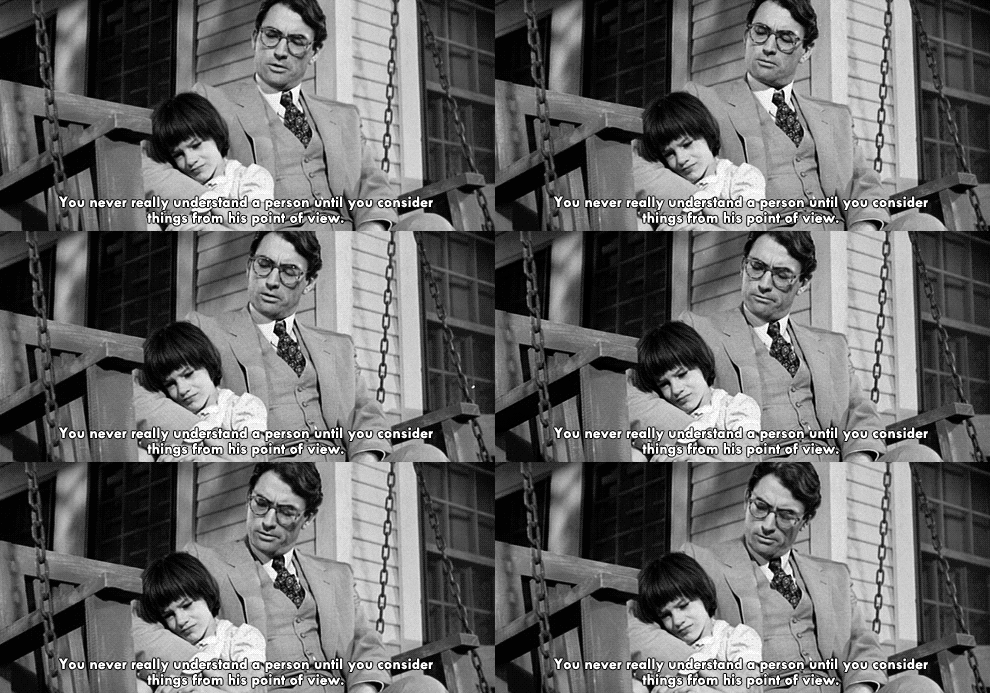
Then, I truly realized what Wallace actually meant. The fact that the fish didn't know what water was really goes to shows how oblivious we are to even the simplest of things that lie right in front of us. In addition Wallace also demonstrates how individuals are just blatantly selfish, and how we are the "lords of our tiny skull-sized kingdoms" (Wallace 11.6). Wallace indicates that we as people are so self-centered that we only are able to think from our own perspective and not the perspectives of others. He also says that true freedom is one in which one must break free of this "default setting" of self-centeredness. Moreover, he challenges people to attain this freedom and think from the perspective of others by learning to "step in [others'] shoes and walk around in them"(Harper Lee, To Kill a Mockingbird).

gregory peck classic film to kill a mockingbird
Image result for open mindednessRelated imageImage result for freedom