 Back when I was younger, if someone were to ask me how aware I was of my surroundings, I would have said that I was mostly aware of what was around me. However, this all changed after reading the introduction of David Foster Wallace's commencement address at Kenyon College.
"These are these two young fish swimming along, and they happen to meet an older fish swimming the other way, who nods at them and says, 'Morning boys, how's the water?' And the two young fish swim on for a bit, and then eventually, one of them looks over at the other and goes, 'What the hell is water?'" (Wallace 1.1-5).
As I read this short fable, that same certainty I once had in my awareness of my surroundings turned into complete doubt. As I read the fable, I thought to myself, "These fish don't know what water is even though they have been living in it their entire life. Are they dumb or what?" Baffled by this fact, I wondered how the younger fish didn't know what water is. Then, I questioned, "Am I really aware of my surroundings?"
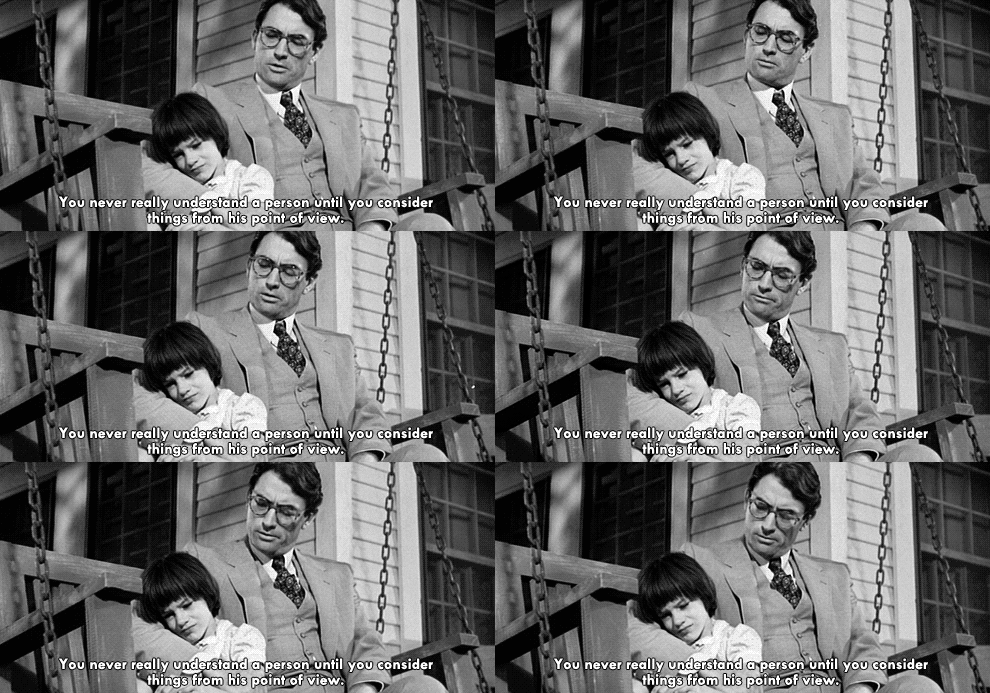
Then, I truly realized what Wallace actually meant. The fact that the fish didn't know what water was really goes to shows how oblivious we are to even the simplest of things that lie right in front of us. In addition Wallace also demonstrates how individuals are just blatantly selfish, and how we are the "lords of our tiny skull-sized kingdoms" (Wallace 11.6). Wallace indicates that we as people are so self-centered that we only are able to think from our own perspective and not the perspectives of others. He also says that true freedom is one in which one must break free of this "default setting" of self-centeredness. Moreover, he challenges people to attain this freedom and think from the perspective of others by learning to "step in [others'] shoes and walk around in them"(Harper Lee, To Kill a Mockingbird).


Hey Rohit,
ReplyDeleteI really enjoyed your post. My favorite part was probably the connection to To Kill a Mockingbird; I had never thought about how these two pieces connected together. It was really interesting to read from your perspective. Looking forward to more posts!